Positioning widget
The question: “How were reported accounts or tracked positions positioned?”
Show the available long/short positioning for this asset.
The widget shows whichever positioning dataset the source returned: long/short account shares as percentages (the usual default), account ratios, or tracked-cohort position values. The scope line says which one you are reading.
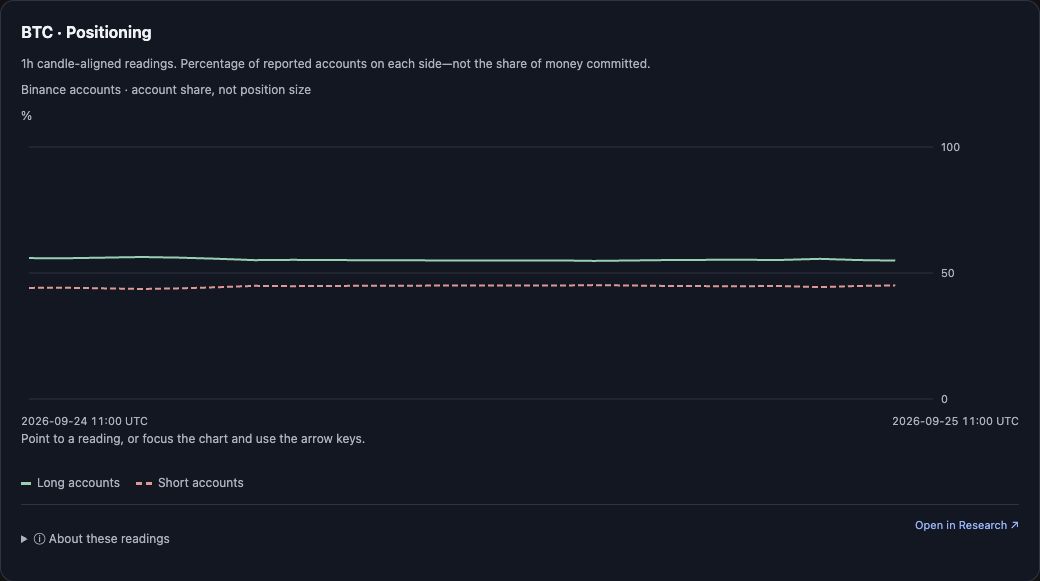
Captured 25 September 2026: BTC · Positioning, 1h candle-aligned account shares in percent, 2026-09-24 11:00 → 2026-09-25 11:00 UTC, with Long accounts / Short accounts and the “account share, not position size” scope. Select the image to view it full size.
Controls
- The widget has no selector for choosing the dataset or the measure. What it shows is determined by the returned result:
- Account shares (the usual default): Long accounts and Short accounts as percentages on a 0–100 scale, when the source returns the share of reported accounts on each side. The scope line then reads Binance accounts · account share, not position size.
- Ratio fallback: All accounts, Top accounts and Top positions as ratios, when the source returns ratios instead of shares.
- Tracked cohort: Tracked long positions and Tracked short positions in USD, with the scope Tracked Hyperliquid cohort · position value, not the whole market.
- The legend names the series actually plotted.
- Shared controls: Expand when the host supports fullscreen, Get a fresh read, Open in Research ↗.
Units, selection and limits
- Account shares are percentages; a higher long share means more reported long accounts, not more money committed.
- In the ratio fallback, above 1 means more long than short accounts or positions in the stated group.
- Tracked-cohort position values are USD for the tracked cohort, not market-wide holdings.
- These are snapshot readings, not flows; a changing share or ratio does not by itself prove new positions were opened.
A useful follow-up
Compare the account share with the tracked position value. Do they tell the same story?